

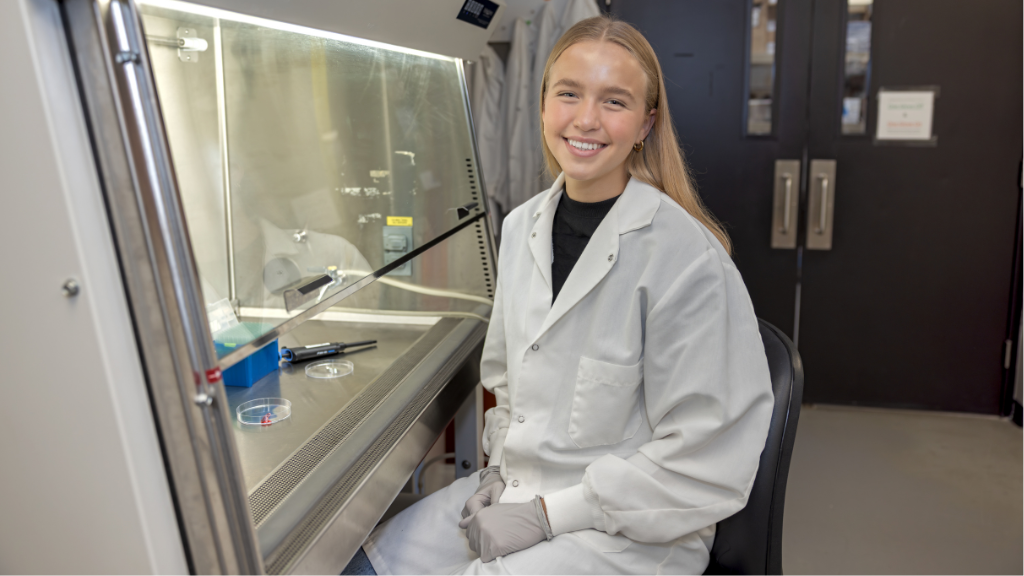
Kaia Van Der Merwe is a student at Watertown High School in South Dakota. She completed the PROMISE Scholar Program during the summer of 2025 working in the Chandrasekar Lab at Sanford Research.
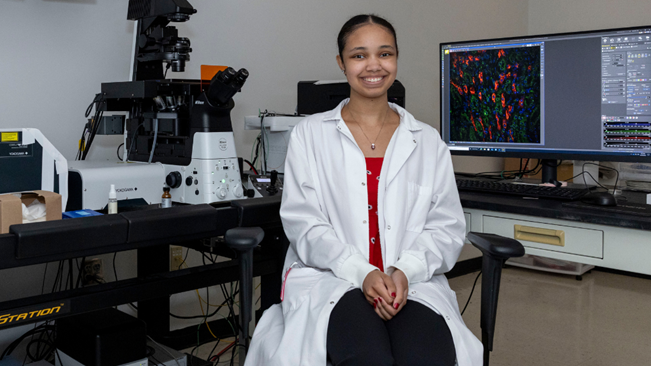
Naomi Jespersen is a student at Lincoln High School in Sioux Falls, South Dakota. She completed the PROMISE Scholar Program during the summer of 2025 working in the Pilaz Lab at Sanford Research.
What are your plans for the future? Do you have a specific career goal or education path?
“I’ve always wanted to be a physician, and the plan for that is undergrad first” says Kaia. “I plan to major in neuroscience. That seems more interesting to me than just biology or chemistry. Then, I would apply to medical school, and I’m also debating whether to pursue the surgery route or not.”
According to Naomi, “That’s the big question everyone is always asking. I’m not sure what I want to do for college yet. No matter what, I want to be a doctor. That’s something I’ve solidified through shadowing and this experience. But now, I’m interested in public health policy, too.”
After their experience this summer, both students also mention that they are very interested in taking the MD/PhD route to keep research in their futures, especially after meeting with MD/PhD students here at Sanford Research.
What did your lab investigate this summer?
Naomi worked in the Pilaz lab, which researches brain health and neurodegenerative disease. Her project focused on the patient mutations in the ZBTB7A gene that are associated with macrocephaly. She studied the circular RNA corresponding to the gene with the goal of using CRISPR/Cas9 to insert a tag that could be used to see if the ZBTB7A protein was formed.
Kaia was placed with the Chandrasekar lab, which investigates the role of kidney disease caused by ion/molecule transport issues. Kaia looked at how knockout, or disabling, of the genes MYH9 and MYH10 affect kidney function, along with the impact of no potassium in the diet on both healthy and diseased kidneys. The two genes code for myosin, which is crucial for cell movement.
Before research, did you have an interest in science?
“Yes, definitely. My interest in science was why I did research” says Kaia. “People say you should be a well-rounded student, but I say that most of my interests are directed toward science”
“Science has always been my favorite subject…I’ve always had that strong interest, but I didn’t think it was applicable to my life” explains Naomi.
What did you think research would be like before you started this summer?
Naomi mentions “I knew it was going to be complex, and a lot of moving parts, but I didn’t realize just how many moving parts it is. I tend to overestimate things, and I underestimated quite a bit.”
As for Kaia, she “had no idea what research was going to be like because I had no exposure to research beforehand. I did have some goals coming into the summer. I wanted to get deeper into biology. I also wanted to meet other people that are well-established in the field of science.”
What skills did research teach you, and what lessons did you learn?
“Accepting failure and being able to move past your mistakes” recalls Naomi. “Your science isn’t always going to go perfectly. There is the cliché ‘don’t be afraid to ask questions’, but you have to ask a lot of questions. Also, you are going to have to step out of your comfort zone, but you will reap the benefits of it. I was talking with scientists who literally invented famed protocols!”
“I learned how to dive deeper into a subject on my own” explains Kaia. “When I’m looking at something that doesn’t make sense, I can go read a paper that explains it properly. Also, before coming, science seemed very competitive, but I saw a lot of collaboration. It can be a friendly experience and a welcoming experience to share new ideas.” If she picked a lesson, it would be that “Other scientists have been in my place, and they understand it is a learning experience. I think it is important to understand that you are capable of becoming great and that you shouldn’t let imposter syndrome hold you down.”
What do you think are benefits of researching while in high school?
“I think it is important especially in South Dakota, a rural area, to get the advice you need from people established in a science career that you won’t get anywhere else in a small area” Kaia mentions.
Naomi says “It honestly showed me just how big the world is, seeing how this one gene has been researched by my whole lab for years and years, and we still don’t know so much about it. Getting to meet so many people from so many backgrounds at a young age was fascinating. It’s something that not all high schoolers, especially high schoolers from South Dakota, get.”
Would you recommend a research opportunity like this to other students?
“A million times yes. Even if you’re not that interested in science, I think it will make you interested in science because you get so attached to what you’re doing” replies Naomi. “The character development and all the other skills it taught me besides the science are so valuable, and they have helped me grow as a person so much.”
For more information about the PROMISE Scholar program, visit this page. Other opportunities for high school students—like our Teen Science Café, shadowing program, and community lectures—can also be found on our website.