

Calista Sahr, a student at Madison Central High School, conducted research in the Weimer Lab during the summer of 2026
Reid Hammerquist, a student at Tea Area High School, conducted research in the Kareta Lab during the summer of 2026
What are your future plans? Any specific career goals or education paths you plan on taking?
Calista: “I plan on going to college for medical biology, and then later on, going to medical school to become a doctor. Currently I'm thinking more of anesthesiology or something like that, but, of course, that's subject to change.”
Reid: “I plan on going to a university and majoring in biochemistry. I want to try to do research in undergrad and get started on that early. Past that, just see where life takes me, I guess.”
What did you investigate this summer?
Reid: “This summer I was in the Kareta lab. I worked with 2 proteins and using drug inhibitors on them to see if they play a role in small cell lung cancer’s cell growth.”
Calista: “I was working in the Weimer Lab this summer, and what we studied are lysosome storage disorders. The one we focus on the most is called Batten’s disease, and it is a family of lysosome storage disorders that affect 13 different genes. What these lysosomes storage disorders affect are the neurons of the brain that can't get rid of waste properly and so they break down. More specifically, we're looking at finding biomarkers that can detect disease and patients and see some prognostic care so we can see if treatment's working.”
What skills did research teach you and what lessons did you learn?
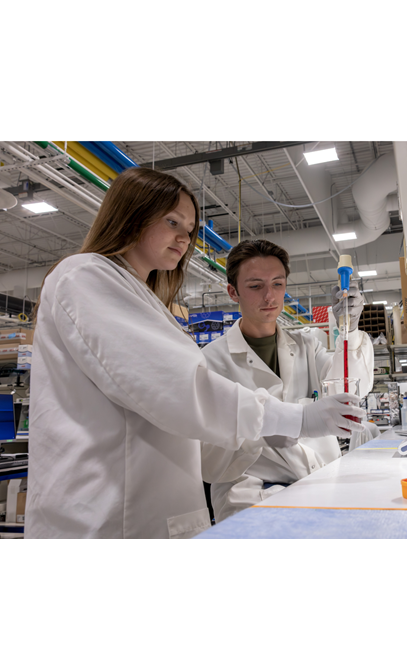
Calista: “More on the technical side of things, I've definitely learned a lot of hands-on skills. I've never pipetted before I came here, and I got to work on brain slicing and that was really cool.
But more than that, I learned how to read a research paper. To critically think about the research- to really dissect it. Where are the limitations of this paper? What makes this paper so good or so important? Additionally, I feel like my communication skills, especially in front of larger crowds, have gotten so much better than they were at the start of the summer. I've spoken in front of crowds before the summer, but I just feel a lot more comfortable and like I can be myself in front of people now. So that's been awesome.”
Reid: “Research has taught me a lot of hard skills. I've learned so many different lab techniques and how to work in a research lab. But it's also taught me intellectual information and how to think like a researcher. Changing your mentality to use the scientific method when you process things and think about different questions.”
What do you think are the benefits of doing research while in high school?
Reid: “I think it's a great way to understand if that's a profession or activity that you want to pursue in college. It's a great way to understand, like, hey, this is something that I want to pursue or maybe it's not for me. But it's also a really good way to continue to develop the scientific pathway you started in school. A lot of it is information that you probably learned a little bit in school, but it's expanded on it so much. Then you get to apply it to hands-on science.”
Calista: “I know some people in this program that knew they wanted a career in research, so they are doing this program. I want to become a doctor, but I want to see if I like this as well. It's just a great way of just really solidifying what you want to do in the future. And I think that it's really important, especially as an upcoming senior, because college is right around the corner to see that stuff before you actually go into it.”
How do you think working in research will benefit a person going into a medical field?
Calista: “I think it's a really great gateway program to get into just the scientific and medical space in general. Everything a doctor practices has to be researched before it can go to patients. So, I think it's very important to see the background and to gain an appreciation for it before you go into that field.”
What was the most rewarding part of this experience?
Reid: “I think getting to know that what I'm doing is actually developing something in science and developing information that potentially nobody has found yet. Knowing that I'm helping my lab, not just with busy work, but something that will further develop their scientific questions and help, hopefully, push them to find actual information that'll help cure cancer.”
Calista: “I honestly think the people I met are the most rewarding part. The other scholars and I are very close. We were just hanging out this morning and talking about our different projects. My mentors have been just amazing to me and have really helped me every step of the way- to challenge me as well as encourage me. I've met a bunch of different people and those relationships I’ll really keep with me.”
What would you tell a student who is considering applying for the PROMISE scholar program?
Calista: “I would tell them to be willing to take open doors. If you think this might be something you're interested in, just apply. I know when I first heard about this program, I actually wasn't going to apply. I just didn't think I had any shot of getting in. But honestly, as you go through the process, you'll realize, okay, maybe there's something special about me that I just didn't realize before. So, take those open doors if you can.”
Reid: “I would say that no matter how nervous you are about it, apply. Because I was worried about if I wouldn't get in, or if it would take up too much my summer, or if I wouldn't enjoy it. And I've ended up loving it so much more than I could have thought. I am so grateful that I was able to experience this summer internship. So, I would say, no matter what your worries are, apply and see what happens.”
The PROMISE Scholars Internship requires an application to be submitted. Applications typically open in early October and are due by early January. You must be in your junior year of high school to apply. Check the PROMISE Scholar Page for more information. Follow us on Facebook or Instagram (@sanfordPROMISE) to be the first to know when applications open.