

Advancing Type 1 Diabetes Research
Sanford Health is offering general population screening for type 1 diabetes and celiac autoantibodies through the PLEDGE study (Population Level Estimate of type 1 Diabetes risk Genes in Children).
The central innovation in PLEDGE is the integration of study procedures into routine pediatric care across all Sanford clinics. In addition to assessing efficacy, this will enable measurement of costs and cost savings.
These economic analyses will be critical to support inclusion of these tests in standard pediatric screening recommendations. Sanford Health is seeking to enroll ~ 20,000 children. Sanford patients under 6 years or between 9-16 years of age are eligible.
Why screen for type 1 diabetes?
Type 1 diabetes (T1D) results from autoimmune destruction of pancreatic beta cells that produce insulin. At the centennial of insulin’s discovery, it remains the mainstay of treatment but does nothing to address autoimmunity. There are other drugs currently in development, and now with approval of teplizumab for Stage 2 T1D, we have the first drug targeting the autoimmunity causing T1D, along with additional drugs currently in development.
However, for any interventions to be used, we need to identify who might benefit from these therapies.
The majority of children who develop T1D, present at a late stage with diabetic ketoacidosis (DKA), necessitating hospitalization and intensive care. DKA at presentation is associated with worse long-term glycemic control and cognitive deficits compared to those who were able to start insulin earlier and avoid DKA. Preventing initial DKA would be expected to decrease long-term complications with associated morbidity, mortality and related healthcare costs.
Hyperglycemia develops after a long period of autoimmunity, providing a window of opportunity to identify children at higher risk of progressing to overt diabetes. Early identification and family awareness can enable ongoing monitoring and appropriate testing so that insulin can be started early enough to prevent serious illness.

Such an approach has been shown in the ASK study to reduce the rate of DKA at presentation from 60% to 3%. In the long term, identifying these high-risk children will enable trials of prevention therapies. In the meantime, there are significant benefits to preventing DKA at presentation.
Why screen all children?
To date, it has been challenging to screen beyond immediate family members of people with T1D. However, 90% of people with T1D do not have a family history for the disease.
Programs to offer screening more widely – such as the TEDDY, Fr1da and ASK studies – have relied on clinical research staff to recruit children from clinics, an approach that is costly and difficult to scale.
For eventual acceptance into standard primary care, any population-based screening tool must be simple, reliable, cost-effective and easily implemented when children are present for routine visits.
The screening process
A blood spot for a targeted SNP-based genetic risk score (GRS) is taken at study entry. For children enrolled prenatally, this can be collected simultaneously with routine newborn screening samples.
Anti-islet antibodies are collected at routine clinic appointments at about 2 years and again at about 5 years of age, or once between 9 and 16 years of age.
At the latter screenings, celiac antibodies are also collected, the inclusion of which has shown increased family engagement in other T1D screening programs.
.png?h=528&w=885&hash=79957D8A62A57BD25D9531D7AD70839C)
Critical to the success of this project is the innovative use of the electronic health record and its associated patient messaging tools. Sanford Health has leveraged these platforms to automate invitations to participate, enable documentation of consent, administer participant surveys, enter orders, and return results.
The success of PLEDGE has relied on the existing infrastructure of Sanford’s integrated health system. Labs are collected at routine clinic visits, specimens are sent to hub laboratories and sent to Sanford’s Reference Lab for batching, processing and shipping to Pacific Northwest Research Institute and Barbara Davis Center.
As part of this project, economic modeling will be performed to assess costs and savings related to this screening approach. We will use real-world data from our health system and insurance plan to determine economic impacts. This data will be important factors when considering T1D screening inclusion in recommendations for standard preventative care.
Children with T1D-related antibodies
Children identified to have persistent T1D autoantibodies are offered ongoing education, monitoring, or enrollment in appropriate intervention trials.
Monitoring is tailored to the individual’s risk. Throughout the monitoring process, we maintain communication with the primary care team and the shared electronic health record is flagged for easy recognition of antibody positive children to encourage appropriate testing in case they present for care with T1D symptoms.
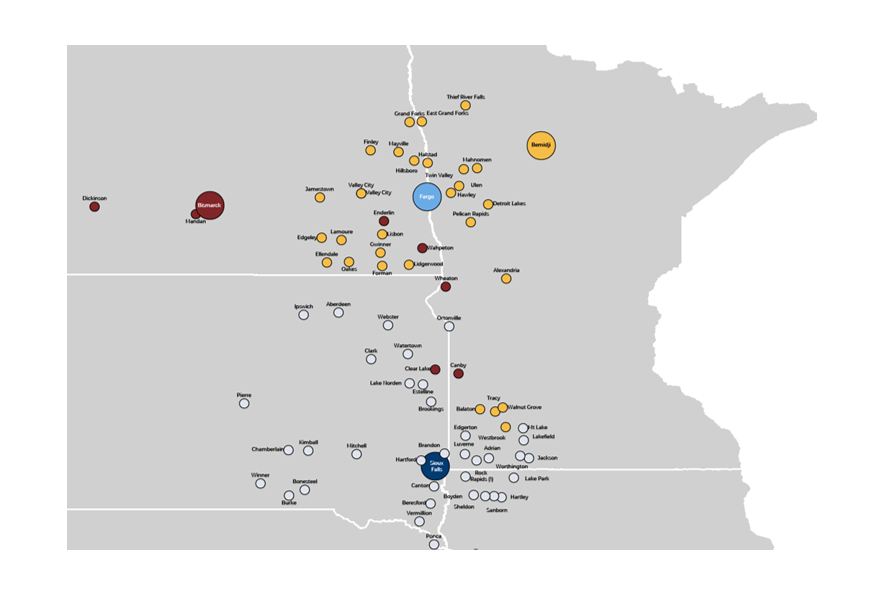
Sanford Pledge Sites
Our Partners
The PLEDGE Study is generously supported by Sanford Health and the Leona M. and Harry B. Helmsley Charitable Trust. Collaborators include William Hagopian, MD, PhD, from the Pacific Northwest Research Institute and Richard Oram, PhD, from the University of Exeter and the Royal Devon and Exeter Hospital, and Marian Rewers, MD, PhD from the Barbara Davis Center for Childhood Diabetes, University of Colorado.
For research-related questions about the Sanford PLEDGE study, email Kurt Griffin, PhD, MD.
Request information about enrolling a child through My Sanford Chart.

